Why BIM Engineers Will Be the Most In-Demand Professionals in 2026
The Future Belongs to the Prepared
The Architecture, Engineering, and Construction (AEC) industry is undergoing one of the biggest transformations in its history. Traditional 2D drafting is rapidly being replaced by intelligent 3D Building Information Modeling (BIM), and companies worldwide are looking for professionals who can design, coordinate, and deliver projects efficiently.
As we move into 2026, BIM Engineers are no longer just designers—they are becoming the backbone of modern construction. From skyscrapers in Dubai to hospitals in the UK, metro projects in India, and smart cities across the world, BIM professionals are shaping the future of infrastructure.
If you’re wondering whether BIM is a good career choice, the answer is clear:
There has never been a better time to become a BIM Engineer.
The Global Construction Industry is Growing Faster Than Ever
Governments and private developers are investing billions into:
- Smart Cities
- Commercial Buildings
- Airports
- Metro Rail Projects
- Data Centers
- Hospitals
- Industrial Plants
- Green Buildings
- Infrastructure Development
Every one of these projects demands higher accuracy, faster execution, and better collaboration.
This is exactly where BIM becomes indispensable.
Instead of relying on traditional drawings, BIM creates an intelligent digital model containing every detail of a building before construction even begins.
What Exactly is BIM?
Building Information Modeling (BIM) is not just software.
It is a complete digital process where architects, structural engineers, MEP engineers, contractors, and project managers work together using a single intelligent model.
The model contains:
- Architectural Information
- Structural Components
- Mechanical Systems
- Electrical Networks
- Plumbing Systems
- Fire Fighting Systems
- Material Specifications
- Cost Information
- Construction Schedule
- Facility Management Data
Everything is connected.
When one element changes, the entire model updates automatically.
Why Companies Prefer BIM Engineers Over Traditional Draftsmen
Construction mistakes are expensive.
A single clash between HVAC ducts and structural beams can delay projects by weeks and cost thousands—or even millions—of dollars.
BIM Engineers identify these issues before construction starts.
This leads to:
- Fewer site errors
- Reduced rework
- Faster approvals
- Lower project costs
- Improved coordination
- Better communication
- Higher quality construction
Companies save enormous amounts of money by hiring skilled BIM professionals.
BIM is Becoming Mandatory Worldwide
Many countries now require BIM for government and large-scale infrastructure projects.
Countries leading BIM adoption include:
- United Kingdom
- United States
- UAE
- Saudi Arabia
- Singapore
- Australia
- Canada
- Qatar
- Norway
- Finland
Even India is rapidly embracing BIM for:
- Metro Rail
- Smart Cities
- Airports
- Hospitals
- Government Buildings
- High-rise Developments
This has created a massive demand for BIM Engineers across the globe.
The Rise of Digital Construction
Construction is entering the era of digital transformation.
Today’s projects integrate:
- Artificial Intelligence (AI)
- Digital Twins
- IoT Sensors
- Cloud Collaboration
- Laser Scanning
- Reality Capture
- Virtual Reality
- Augmented Reality
- Drone Surveying
BIM serves as the central platform connecting all these technologies.
Engineers who understand BIM will be at the center of this digital ecosystem.
BIM Engineers Are in Demand Across Multiple Industries
Unlike many professions limited to one sector, BIM Engineers have opportunities in diverse industries, including:
Commercial Buildings
Office towers, shopping malls, hotels, and mixed-use developments.
Healthcare
Hospitals require highly coordinated MEP systems.
Industrial Plants
Factories, pharmaceutical plants, and manufacturing facilities.
Airports
Complex systems requiring advanced BIM coordination.
Oil & Gas
Highly detailed plant modeling and asset management.
Infrastructure
Metro projects, bridges, tunnels, and highways.
Data Centers
One of the fastest-growing sectors requiring precision MEP and BIM expertise.
BIM Skills Companies Want in 2026
Recruiters are no longer looking for candidates who only know AutoCAD.
They want professionals skilled in:
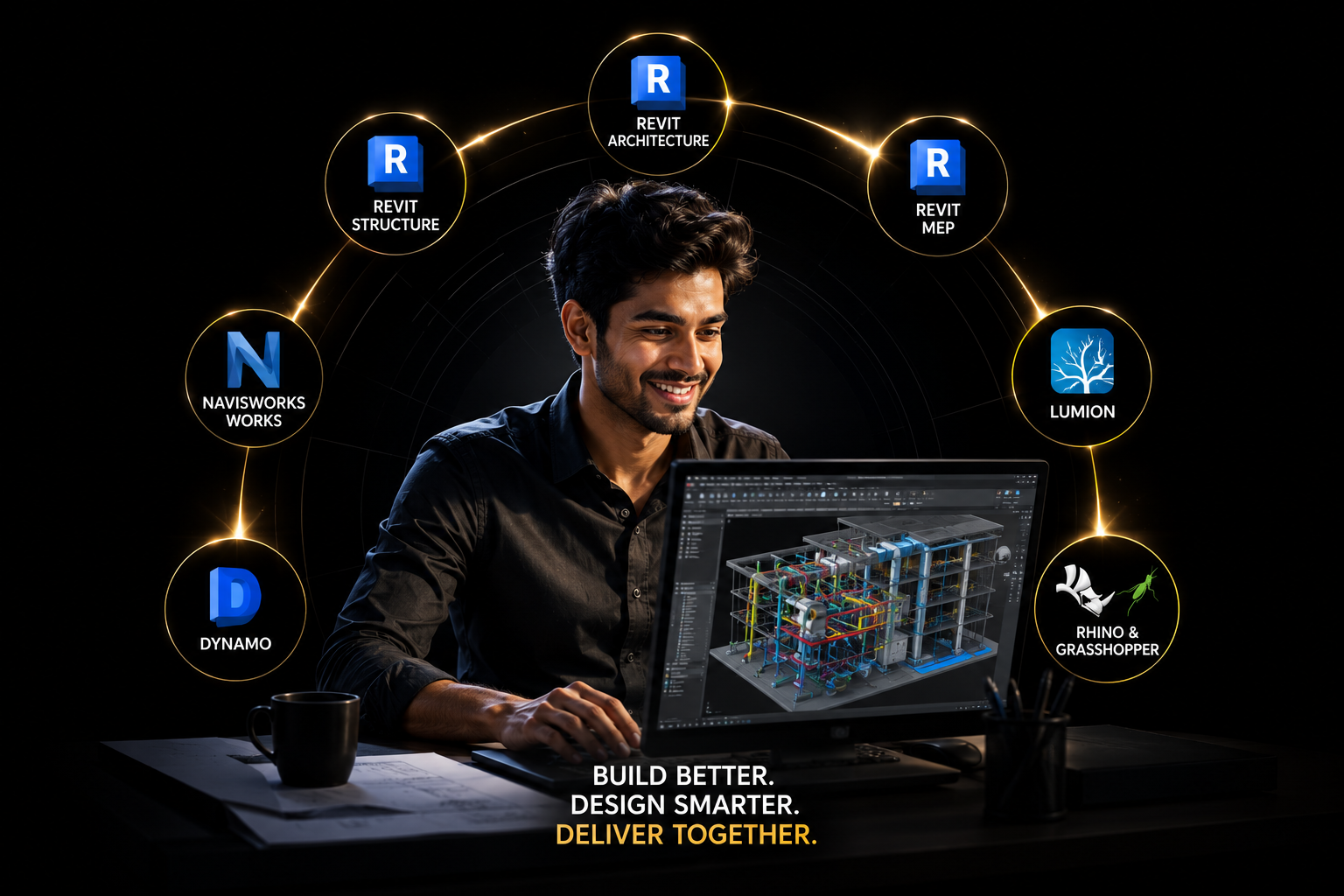
- Autodesk Revit
- Navisworks
- AutoCAD
- BIM Coordination
- Clash Detection
- BIM 360 / Autodesk Construction Cloud
- Dynamo
- Quantity Takeoff
- Construction Documentation
- Project Coordination
- MEP Modeling
- Structural Modeling
- Architectural Modeling
Candidates with multidisciplinary knowledge have a significant advantage.
Why MEP BIM Engineers Have the Biggest Advantage
MEP systems are among the most complex components of any building.
Mechanical
Electrical
Plumbing
Fire Fighting
HVAC
Drainage
Medical Gas
Electrical Distribution
All these systems must fit perfectly within the architectural and structural framework.
This complexity makes MEP BIM Engineers some of the most valuable professionals in the industry.
Companies cannot afford coordination errors.
That is why skilled MEP BIM Engineers are highly sought after.
AI Will Not Replace BIM Engineers
Many people fear Artificial Intelligence will eliminate engineering jobs.
The reality is different.
AI is helping BIM Engineers become more productive.
AI can:
- Automate repetitive tasks
- Generate layouts
- Detect clashes faster
- Improve workflows
- Optimize designs
However, AI cannot replace:
- Engineering judgment
- Design decisions
- Code compliance
- Site coordination
- Client communication
- Problem-solving
- Project management
The future belongs to professionals who know how to work with AI, not against it.
Career Opportunities for BIM Engineers
A BIM professional can grow into multiple career paths, including:
- BIM Modeler
- BIM Engineer
- MEP BIM Engineer
- BIM Coordinator
- BIM Lead
- BIM Manager
- BIM Consultant
- Digital Construction Specialist
- BIM Project Manager
- Digital Engineering Manager
With experience, professionals can transition into leadership and consulting roles.
Global Job Opportunities
One of the biggest advantages of BIM is its international demand.
Countries actively hiring BIM professionals include:
- UAE
- Saudi Arabia
- Qatar
- Oman
- Kuwait
- United Kingdom
- Ireland
- Canada
- Australia
- Germany
- Singapore
Many Indian BIM Engineers have built successful careers abroad due to their technical expertise and experience.
Salary Potential
While salaries vary by country and experience, BIM professionals typically earn significantly more than traditional CAD draftsmen because they contribute directly to project coordination, efficiency, and cost savings.
Professionals with expertise in multidisciplinary BIM, clash detection, coordination, and international project standards often command premium salaries in global markets.
Essential Skills to Stay Ahead
Success in BIM isn’t just about software proficiency.
Develop these additional skills:
- Engineering Fundamentals
- Communication Skills
- Team Collaboration
- Project Coordination
- Problem Solving
- Time Management
- Construction Knowledge
- International Standards
- Continuous Learning
Technical knowledge combined with soft skills creates exceptional BIM professionals.
Why Students Should Start Learning BIM Now
Waiting until graduation or after several years of work experience may mean missing valuable opportunities.
Students who begin learning BIM early gain:
- Better placement opportunities
- Higher starting salaries
- International career options
- Stronger technical confidence
- Faster career growth
- Better project understanding
The earlier you start, the stronger your competitive advantage.
Why Companies Are Investing in BIM Talent
Organizations adopting BIM report measurable benefits:
- Faster project delivery
- Improved coordination
- Reduced material wastage
- Better cost control
- Enhanced project visualization
- Higher construction quality
- Improved client satisfaction
- Greater lifecycle value through digital asset management
This is why businesses continue investing in BIM technology—and more importantly, in skilled BIM professionals.
The Future of BIM Beyond 2026
BIM is evolving rapidly with technologies such as:
- AI-assisted design
- Digital Twins
- Generative Design
- Robotics in Construction
- Smart Buildings
- IoT Integration
- Predictive Maintenance
- Cloud-based Collaboration
- Sustainable Design Analytics
The BIM Engineer of the future will be more than a modeler—they will be a digital construction specialist driving innovation across the entire building lifecycle.
Final Thoughts
The construction industry is no longer relying solely on drawings; it is embracing intelligent, data-driven models that improve every stage of a project’s lifecycle. As digital construction becomes the global standard, the demand for skilled BIM Engineers will continue to rise.
For aspiring engineers, this is more than just learning new software—it’s about building a career that is future-ready. Whether your goal is to work on iconic skyscrapers, infrastructure projects, healthcare facilities, or smart cities, BIM provides the skills that employers value most.
The future doesn’t wait for those who hesitate. It rewards those who prepare.
If you’re ready to build a career with global opportunities, high growth potential, and cutting-edge technology, 2026 is the perfect time to become a BIM Engineer.
About ACE India Training & Services Pvt. Ltd.
With over 18 years of excellence, ACE India Training & Services Pvt. Ltd. has been empowering engineers through industry-focused MEP and BIM training programs. Our curriculum combines practical learning, live project exposure, and guidance from experienced professionals to help students become job-ready for both Indian and international markets.
Whether you’re a student, graduate, diploma holder, or working professional looking to upskill, ACE India provides the knowledge and confidence needed to succeed in today’s rapidly evolving construction industry.
The future belongs to the prepared. Prepare with ACE India.