The ₹8–15 LPA Skill Most Engineering Colleges Still Don’t Teach
Why Thousands of Engineering Graduates Struggle for Jobs While BIM Professionals Build Global Careers
Every year, India produces over a million engineering graduates.
Yet, many fresh Mechanical, Electrical, Civil, and Architecture graduates face the same challenge:
❌ No campus placement
❌ Low starting salary
❌ Limited practical exposure
❌ Lack of industry-ready skills
Meanwhile, another group of engineers is quietly building successful careers—not because they scored the highest marks, but because they possess a skill that most engineering colleges still don’t teach.
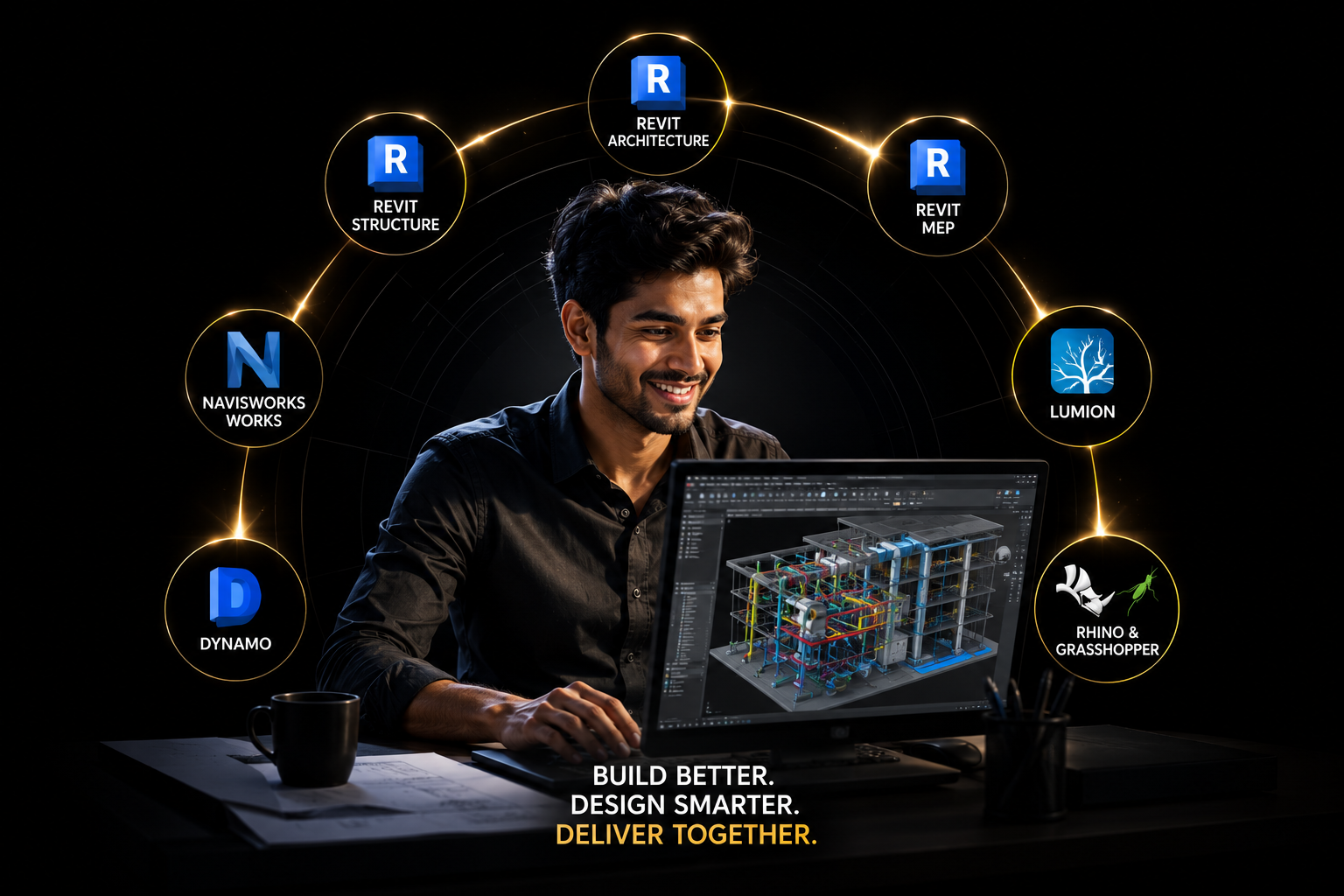
That skill is BIM (Building Information Modeling) integrated with MEP Engineering.
And in today’s global construction industry, it has become one of the most valuable career skills.
The Engineering Reality in 2026
Ask any engineering graduate what they learned in college.
Most will mention:
- Engineering Theory
- Engineering Mathematics
- Laboratory Sessions
- Semester Projects
- CAD Basics
While these subjects are important, there’s one major problem.
Most graduates have never worked on a real construction project before attending their first interview.
Employers aren’t just looking for degrees anymore.
They’re looking for engineers who can contribute from Day One.
The Skill Gap Employers Talk About
Construction companies today aren’t asking,
“What’s your CGPA?”
They’re asking,
- Can you work in Autodesk Revit?
- Can you coordinate MEP services?
- Can you read construction drawings?
- Can you detect clashes?
- Can you prepare shop drawings?
- Can you extract quantities?
- Can you collaborate in BIM workflows?
Unfortunately, many graduates answer “No.”
This is where the opportunity begins.
What Exactly Is BIM?
Building Information Modeling (BIM) is much more than 3D modeling.
It is a digital process where architects, structural engineers, MEP engineers, contractors, and project managers collaborate on a single intelligent model.
Instead of working on isolated drawings, everyone works together in a coordinated environment.
This reduces:
✔ Design errors
✔ Construction delays
✔ Material wastage
✔ Project costs
✔ Rework on site
Today, BIM has become the global standard for modern construction projects.
Why MEP BIM Engineers Are in High Demand
Every commercial building depends on its MEP systems:
- HVAC
- Electrical
- Plumbing
- Fire Fighting
Without proper coordination, these systems can clash with each other and with structural elements, leading to costly delays.
A skilled MEP BIM Engineer ensures that these issues are identified and resolved before construction begins.
That’s why consultants and contractors across India and the GCC are actively hiring professionals with BIM expertise.
Why Salaries Are Increasing
Companies are willing to pay more—not simply because someone knows software, but because they can solve real project problems.
A skilled BIM professional can:
- Improve project coordination
- Reduce costly site errors
- Increase construction efficiency
- Deliver projects faster
- Save companies significant time and money
Professionals who consistently deliver this value often see their salaries grow much faster than those in traditional drafting roles.
Many engineers, after acquiring strong BIM and MEP skills and gaining relevant industry experience, progress into roles with annual compensation in the ₹8–15 LPA range, depending on factors such as experience, project exposure, location, employer, and technical expertise.
The focus should not be on chasing a salary—but on building the skills that create long-term career growth.
The Skills That Make You Valuable
If you want to stand out, focus on mastering both engineering fundamentals and digital construction tools.
Technical Skills
- HVAC Design
- Electrical Design
- Plumbing Design
- Fire Fighting Systems
- Building Services
BIM Software
- Autodesk Revit MEP
- Navisworks
- AutoCAD
- BIM Coordination
- Clash Detection
- Quantity Take-Off
Digital Skills
- AI-assisted workflows
- Construction documentation
- Cloud collaboration
- Digital project coordination
Professional Skills
- Communication
- Teamwork
- Problem-solving
- Time Management
- Client Coordination
These are the capabilities that employers increasingly value.
Why Engineering Colleges Alone Aren’t Enough
Traditional engineering education builds a strong academic foundation.
But the construction industry expects practical knowledge.
Companies want engineers who understand:
- Live project workflows
- Coordination meetings
- Real construction drawings
- Industry standards
- BIM execution
- Site challenges
This practical exposure is often gained through specialized training and real-world project experience.
The Global Opportunity
Countries across the GCC—including the UAE, Saudi Arabia, Qatar, Oman, Kuwait, and Bahrain—are investing billions in:
- Smart Cities
- Airports
- Hospitals
- High-rise Buildings
- Industrial Plants
- Data Centres
- Metro Projects
These developments increasingly rely on BIM workflows, creating strong demand for professionals with the right technical and digital skills.
For engineers who invest in continuous learning, the opportunities are expanding both in India and internationally.
How ACE India Helps You Bridge the Gap
At ACE India Training & Services Pvt. Ltd., we understand what employers expect because we are not just trainers—we are also engineering consultants.
Our BIM Integrated MEP Training Program is designed to make graduates industry-ready through:
✅ Practical MEP Engineering
✅ Autodesk Revit MEP
✅ Navisworks
✅ Real Project-Based Learning
✅ Industry Assignments
✅ Site Visits
✅ BIM Coordination
✅ Interview Preparation
✅ Placement Assistance
Students don’t just learn software—they learn how real engineering projects are executed.
Success Isn’t About the Degree Alone
Imagine two fresh graduates attending the same interview.
Graduate A
- Good academic scores
- Basic AutoCAD knowledge
- Limited practical exposure
Graduate B
- Strong engineering fundamentals
- Practical BIM experience
- Real project exposure
- Coordination knowledge
- Digital construction skills
Which candidate is more likely to stand out?
In today’s construction industry, practical capability often makes the difference.
Final Thoughts
The construction industry is changing rapidly.
Companies are no longer looking only for engineering graduates—they’re looking for engineers who can deliver value from the first day on the job.
BIM and MEP skills have become powerful career accelerators for those willing to invest in continuous learning.
The engineers who thrive in the coming years will be those who combine technical knowledge, practical experience, and digital engineering expertise.
Your degree opens the door. Your skills determine how far you go.
Ready to Build a High-Growth Engineering Career?
Join ACE India Training & Services Pvt. Ltd. and gain practical, industry-focused expertise through our BIM Integrated MEP Training Program. Learn from experienced professionals, work on real-world projects, and build the capabilities that leading engineering companies look for in India and across the GCC.
The future belongs to engineers who never stop learning—and who are ready for the demands of modern construction.