The Building Information Modeling (BIM) industry is rapidly transforming the Architecture, Engineering, and Construction (AEC) sector. Today’s BIM engineers are expected to do much more than create 3D models—they must coordinate multidisciplinary teams, automate workflows, produce realistic visualizations, and deliver projects efficiently.
Whether you’re a student planning your career or a working professional looking to upgrade your skills, mastering the right software is the key to staying competitive. Here are the seven essential software applications every BIM engineer should master in 2026.
1. Autodesk Revit Architecture
Revit Architecture is the foundation of architectural BIM modeling. It enables architects and designers to create intelligent building models that contain both graphical and non-graphical information.
Key Skills to Learn
Architectural Modeling
Walls, Floors & Roofs
Doors & Windows
Families & Components
Schedules
Construction Documentation
Worksharing
Why It Matters
Every architectural BIM project begins with an accurate building model. Revit Architecture helps streamline design changes, improve collaboration, and generate accurate construction documentation.
2. Autodesk Revit Structure
Structural engineers use Revit Structure to design and coordinate structural components within a BIM environment.
Key Skills to Learn
Structural Framing
Reinforced Concrete Modeling
Steel Structures
Foundations
Structural Documentation
Structural Analysis Integration
Rebar Modeling
Why It Matters
A well-coordinated structural model reduces construction errors and improves collaboration between architects and MEP engineers.
3. Autodesk Revit MEP
Revit MEP is one of the most sought-after skills in the global construction industry. It allows engineers to design Mechanical, Electrical, and Plumbing systems within a coordinated BIM model.
Key Skills to Learn
HVAC Modeling
Plumbing Systems
Electrical Systems
Fire Fighting Systems
Equipment Placement
Duct & Pipe Routing
Load Calculations
Shop Drawings
Why It Matters
Revit MEP enables engineers to detect conflicts early, optimize system layouts, and improve project efficiency.
4. Autodesk Navisworks
Navisworks is the industry’s leading software for BIM coordination and project review. It combines models from different disciplines into a single environment for collaboration.
Key Skills to Learn
Clash Detection
Model Coordination
4D Construction Simulation
Quantification
Construction Sequencing
Model Review
Issue Tracking
Why It Matters
Detecting clashes before construction begins helps reduce rework, save costs, and ensure smoother project execution.
5. Lumion
A great BIM model deserves an equally impressive presentation. Lumion transforms technical BIM models into stunning visualizations with realistic lighting, materials, landscapes, and animations.
Key Skills to Learn
Architectural Rendering
Realistic Materials
Landscape Design
Lighting Effects
Walkthrough Animations
Flythrough Videos
Environmental Settings
Why It Matters
Clients can better understand a project through realistic renders and animations, making presentations more impactful and increasing project approvals.
6. Dynamo for Revit
Dynamo is a visual programming tool that automates repetitive tasks within Revit, improving productivity and reducing manual effort.
Key Skills to Learn
Visual Programming
BIM Automation
Parameter Management
Batch Editing
Geometry Creation
Data Extraction
Custom Scripts
Why It Matters
Engineers who can automate workflows save valuable time and improve accuracy, making them highly valuable in BIM teams.
7. Rhino & Grasshopper
Rhino is a powerful 3D modeling software, while Grasshopper is its visual programming platform for creating complex parametric and computational designs.
Key Skills to Learn
Freeform Modeling
Parametric Design
Computational Geometry
Facade Design
Structural Optimization
Algorithmic Modeling
Design Automation
Why It Matters
Modern architectural and engineering projects often feature complex geometries that traditional BIM software cannot easily create. Rhino and Grasshopper enable innovative, sustainable, and highly customized designs.
Why These Software Skills Are Essential
Mastering these seven software applications equips BIM engineers with the ability to:
Develop intelligent BIM models
Coordinate multidisciplinary teams
Detect and resolve design clashes
Automate repetitive workflows
Create high-quality architectural visualizations
Design complex parametric structures
Improve project efficiency and accuracy
Work confidently on international construction projects
The Future of BIM Careers
As the AEC industry embraces digital transformation, companies are seeking professionals who possess expertise across multiple BIM platforms. Engineers with skills in Revit Architecture, Revit Structure, Revit MEP, Navisworks, Lumion, Dynamo, and Rhino & Grasshopper are well-positioned for high-demand roles in architectural design, engineering consultancy, infrastructure development, and smart construction projects worldwide.
Continuous learning and software proficiency not only enhance technical capabilities but also open doors to better career opportunities, higher salaries, and global employment prospects.
Build Your BIM Career with ACE India
At ACE India Training & Services Pvt. Ltd., we provide comprehensive, industry-focused training in the latest BIM software through practical projects, expert mentorship, and real-world workflows. Our programs are designed to prepare students and professionals for the evolving demands of the global AEC industry.
Whether you’re starting your journey or looking to advance your expertise, mastering these seven essential BIM software tools will help you become a future-ready BIM professional.
Invest in your skills today, and shape the buildings of tomorrow with BIM.
]]>The Future Belongs to the Prepared
The Architecture, Engineering, and Construction (AEC) industry is undergoing one of the biggest transformations in its history. Traditional 2D drafting is rapidly being replaced by intelligent 3D Building Information Modeling (BIM), and companies worldwide are looking for professionals who can design, coordinate, and deliver projects efficiently.
As we move into 2026, BIM Engineers are no longer just designers—they are becoming the backbone of modern construction. From skyscrapers in Dubai to hospitals in the UK, metro projects in India, and smart cities across the world, BIM professionals are shaping the future of infrastructure.
If you’re wondering whether BIM is a good career choice, the answer is clear:
There has never been a better time to become a BIM Engineer.
The Global Construction Industry is Growing Faster Than Ever
Governments and private developers are investing billions into:
- Smart Cities
- Commercial Buildings
- Airports
- Metro Rail Projects
- Data Centers
- Hospitals
- Industrial Plants
- Green Buildings
- Infrastructure Development
Every one of these projects demands higher accuracy, faster execution, and better collaboration.
This is exactly where BIM becomes indispensable.
Instead of relying on traditional drawings, BIM creates an intelligent digital model containing every detail of a building before construction even begins.
What Exactly is BIM?
Building Information Modeling (BIM) is not just software.
It is a complete digital process where architects, structural engineers, MEP engineers, contractors, and project managers work together using a single intelligent model.
The model contains:
- Architectural Information
- Structural Components
- Mechanical Systems
- Electrical Networks
- Plumbing Systems
- Fire Fighting Systems
- Material Specifications
- Cost Information
- Construction Schedule
- Facility Management Data
Everything is connected.
When one element changes, the entire model updates automatically.
Why Companies Prefer BIM Engineers Over Traditional Draftsmen
Construction mistakes are expensive.
A single clash between HVAC ducts and structural beams can delay projects by weeks and cost thousands—or even millions—of dollars.
BIM Engineers identify these issues before construction starts.
This leads to:
- Fewer site errors
- Reduced rework
- Faster approvals
- Lower project costs
- Improved coordination
- Better communication
- Higher quality construction
Companies save enormous amounts of money by hiring skilled BIM professionals.
BIM is Becoming Mandatory Worldwide
Many countries now require BIM for government and large-scale infrastructure projects.
Countries leading BIM adoption include:
- United Kingdom
- United States
- UAE
- Saudi Arabia
- Singapore
- Australia
- Canada
- Qatar
- Norway
- Finland
Even India is rapidly embracing BIM for:
- Metro Rail
- Smart Cities
- Airports
- Hospitals
- Government Buildings
- High-rise Developments
This has created a massive demand for BIM Engineers across the globe.
The Rise of Digital Construction
Construction is entering the era of digital transformation.
Today’s projects integrate:
- Artificial Intelligence (AI)
- Digital Twins
- IoT Sensors
- Cloud Collaboration
- Laser Scanning
- Reality Capture
- Virtual Reality
- Augmented Reality
- Drone Surveying
BIM serves as the central platform connecting all these technologies.
Engineers who understand BIM will be at the center of this digital ecosystem.
BIM Engineers Are in Demand Across Multiple Industries
Unlike many professions limited to one sector, BIM Engineers have opportunities in diverse industries, including:
Commercial Buildings
Office towers, shopping malls, hotels, and mixed-use developments.
Healthcare
Hospitals require highly coordinated MEP systems.
Industrial Plants
Factories, pharmaceutical plants, and manufacturing facilities.
Airports
Complex systems requiring advanced BIM coordination.
Oil & Gas
Highly detailed plant modeling and asset management.
Infrastructure
Metro projects, bridges, tunnels, and highways.
Data Centers
One of the fastest-growing sectors requiring precision MEP and BIM expertise.
BIM Skills Companies Want in 2026
Recruiters are no longer looking for candidates who only know AutoCAD.
They want professionals skilled in:
- Autodesk Revit
- Navisworks
- AutoCAD
- BIM Coordination
- Clash Detection
- BIM 360 / Autodesk Construction Cloud
- Dynamo
- Quantity Takeoff
- Construction Documentation
- Project Coordination
- MEP Modeling
- Structural Modeling
- Architectural Modeling
Candidates with multidisciplinary knowledge have a significant advantage.
Why MEP BIM Engineers Have the Biggest Advantage
MEP systems are among the most complex components of any building.
Mechanical
Electrical
Plumbing
Fire Fighting
HVAC
Drainage
Medical Gas
Electrical Distribution
All these systems must fit perfectly within the architectural and structural framework.
This complexity makes MEP BIM Engineers some of the most valuable professionals in the industry.
Companies cannot afford coordination errors.
That is why skilled MEP BIM Engineers are highly sought after.
AI Will Not Replace BIM Engineers
Many people fear Artificial Intelligence will eliminate engineering jobs.
The reality is different.
AI is helping BIM Engineers become more productive.
AI can:
- Automate repetitive tasks
- Generate layouts
- Detect clashes faster
- Improve workflows
- Optimize designs
However, AI cannot replace:
- Engineering judgment
- Design decisions
- Code compliance
- Site coordination
- Client communication
- Problem-solving
- Project management
The future belongs to professionals who know how to work with AI, not against it.
Career Opportunities for BIM Engineers
A BIM professional can grow into multiple career paths, including:
- BIM Modeler
- BIM Engineer
- MEP BIM Engineer
- BIM Coordinator
- BIM Lead
- BIM Manager
- BIM Consultant
- Digital Construction Specialist
- BIM Project Manager
- Digital Engineering Manager
With experience, professionals can transition into leadership and consulting roles.
Global Job Opportunities
One of the biggest advantages of BIM is its international demand.
Countries actively hiring BIM professionals include:
- UAE
- Saudi Arabia
- Qatar
- Oman
- Kuwait
- United Kingdom
- Ireland
- Canada
- Australia
- Germany
- Singapore
Many Indian BIM Engineers have built successful careers abroad due to their technical expertise and experience.
Salary Potential
While salaries vary by country and experience, BIM professionals typically earn significantly more than traditional CAD draftsmen because they contribute directly to project coordination, efficiency, and cost savings.
Professionals with expertise in multidisciplinary BIM, clash detection, coordination, and international project standards often command premium salaries in global markets.
Essential Skills to Stay Ahead
Success in BIM isn’t just about software proficiency.
Develop these additional skills:
- Engineering Fundamentals
- Communication Skills
- Team Collaboration
- Project Coordination
- Problem Solving
- Time Management
- Construction Knowledge
- International Standards
- Continuous Learning
Technical knowledge combined with soft skills creates exceptional BIM professionals.
Why Students Should Start Learning BIM Now
Waiting until graduation or after several years of work experience may mean missing valuable opportunities.
Students who begin learning BIM early gain:
- Better placement opportunities
- Higher starting salaries
- International career options
- Stronger technical confidence
- Faster career growth
- Better project understanding
The earlier you start, the stronger your competitive advantage.
Why Companies Are Investing in BIM Talent
Organizations adopting BIM report measurable benefits:
- Faster project delivery
- Improved coordination
- Reduced material wastage
- Better cost control
- Enhanced project visualization
- Higher construction quality
- Improved client satisfaction
- Greater lifecycle value through digital asset management
This is why businesses continue investing in BIM technology—and more importantly, in skilled BIM professionals.
The Future of BIM Beyond 2026
BIM is evolving rapidly with technologies such as:
- AI-assisted design
- Digital Twins
- Generative Design
- Robotics in Construction
- Smart Buildings
- IoT Integration
- Predictive Maintenance
- Cloud-based Collaboration
- Sustainable Design Analytics
The BIM Engineer of the future will be more than a modeler—they will be a digital construction specialist driving innovation across the entire building lifecycle.
Final Thoughts
The construction industry is no longer relying solely on drawings; it is embracing intelligent, data-driven models that improve every stage of a project’s lifecycle. As digital construction becomes the global standard, the demand for skilled BIM Engineers will continue to rise.
For aspiring engineers, this is more than just learning new software—it’s about building a career that is future-ready. Whether your goal is to work on iconic skyscrapers, infrastructure projects, healthcare facilities, or smart cities, BIM provides the skills that employers value most.
The future doesn’t wait for those who hesitate. It rewards those who prepare.
If you’re ready to build a career with global opportunities, high growth potential, and cutting-edge technology, 2026 is the perfect time to become a BIM Engineer.
About ACE India Training & Services Pvt. Ltd.
With over 18 years of excellence, ACE India Training & Services Pvt. Ltd. has been empowering engineers through industry-focused MEP and BIM training programs. Our curriculum combines practical learning, live project exposure, and guidance from experienced professionals to help students become job-ready for both Indian and international markets.
Whether you’re a student, graduate, diploma holder, or working professional looking to upskill, ACE India provides the knowledge and confidence needed to succeed in today’s rapidly evolving construction industry.
The future belongs to the prepared. Prepare with ACE India.
]]>Why Thousands of Engineering Graduates Struggle for Jobs While BIM Professionals Build Global Careers
Every year, India produces over a million engineering graduates.
Yet, many fresh Mechanical, Electrical, Civil, and Architecture graduates face the same challenge:
❌ No campus placement
❌ Low starting salary
❌ Limited practical exposure
❌ Lack of industry-ready skills
Meanwhile, another group of engineers is quietly building successful careers—not because they scored the highest marks, but because they possess a skill that most engineering colleges still don’t teach.
That skill is BIM (Building Information Modeling) integrated with MEP Engineering.
And in today’s global construction industry, it has become one of the most valuable career skills.
The Engineering Reality in 2026
Ask any engineering graduate what they learned in college.
Most will mention:
- Engineering Theory
- Engineering Mathematics
- Laboratory Sessions
- Semester Projects
- CAD Basics
While these subjects are important, there’s one major problem.
Most graduates have never worked on a real construction project before attending their first interview.
Employers aren’t just looking for degrees anymore.
They’re looking for engineers who can contribute from Day One.
The Skill Gap Employers Talk About
Construction companies today aren’t asking,
“What’s your CGPA?”
They’re asking,
- Can you work in Autodesk Revit?
- Can you coordinate MEP services?
- Can you read construction drawings?
- Can you detect clashes?
- Can you prepare shop drawings?
- Can you extract quantities?
- Can you collaborate in BIM workflows?
Unfortunately, many graduates answer “No.”
This is where the opportunity begins.
What Exactly Is BIM?
Building Information Modeling (BIM) is much more than 3D modeling.
It is a digital process where architects, structural engineers, MEP engineers, contractors, and project managers collaborate on a single intelligent model.
Instead of working on isolated drawings, everyone works together in a coordinated environment.
This reduces:
✔ Design errors
✔ Construction delays
✔ Material wastage
✔ Project costs
✔ Rework on site
Today, BIM has become the global standard for modern construction projects.
Why MEP BIM Engineers Are in High Demand
Every commercial building depends on its MEP systems:
- HVAC
- Electrical
- Plumbing
- Fire Fighting
Without proper coordination, these systems can clash with each other and with structural elements, leading to costly delays.
A skilled MEP BIM Engineer ensures that these issues are identified and resolved before construction begins.
That’s why consultants and contractors across India and the GCC are actively hiring professionals with BIM expertise.
Why Salaries Are Increasing
Companies are willing to pay more—not simply because someone knows software, but because they can solve real project problems.
A skilled BIM professional can:
- Improve project coordination
- Reduce costly site errors
- Increase construction efficiency
- Deliver projects faster
- Save companies significant time and money
Professionals who consistently deliver this value often see their salaries grow much faster than those in traditional drafting roles.
Many engineers, after acquiring strong BIM and MEP skills and gaining relevant industry experience, progress into roles with annual compensation in the ₹8–15 LPA range, depending on factors such as experience, project exposure, location, employer, and technical expertise.
The focus should not be on chasing a salary—but on building the skills that create long-term career growth.
The Skills That Make You Valuable
If you want to stand out, focus on mastering both engineering fundamentals and digital construction tools.
Technical Skills
- HVAC Design
- Electrical Design
- Plumbing Design
- Fire Fighting Systems
- Building Services
BIM Software
- Autodesk Revit MEP
- Navisworks
- AutoCAD
- BIM Coordination
- Clash Detection
- Quantity Take-Off
Digital Skills
- AI-assisted workflows
- Construction documentation
- Cloud collaboration
- Digital project coordination
Professional Skills
- Communication
- Teamwork
- Problem-solving
- Time Management
- Client Coordination
These are the capabilities that employers increasingly value.
Why Engineering Colleges Alone Aren’t Enough
Traditional engineering education builds a strong academic foundation.
But the construction industry expects practical knowledge.
Companies want engineers who understand:
- Live project workflows
- Coordination meetings
- Real construction drawings
- Industry standards
- BIM execution
- Site challenges
This practical exposure is often gained through specialized training and real-world project experience.
The Global Opportunity
Countries across the GCC—including the UAE, Saudi Arabia, Qatar, Oman, Kuwait, and Bahrain—are investing billions in:
- Smart Cities
- Airports
- Hospitals
- High-rise Buildings
- Industrial Plants
- Data Centres
- Metro Projects
These developments increasingly rely on BIM workflows, creating strong demand for professionals with the right technical and digital skills.
For engineers who invest in continuous learning, the opportunities are expanding both in India and internationally.
How ACE India Helps You Bridge the Gap
At ACE India Training & Services Pvt. Ltd., we understand what employers expect because we are not just trainers—we are also engineering consultants.
Our BIM Integrated MEP Training Program is designed to make graduates industry-ready through:
✅ Practical MEP Engineering
✅ Autodesk Revit MEP
✅ Navisworks
✅ Real Project-Based Learning
✅ Industry Assignments
✅ Site Visits
✅ BIM Coordination
✅ Interview Preparation
✅ Placement Assistance
Students don’t just learn software—they learn how real engineering projects are executed.
Success Isn’t About the Degree Alone
Imagine two fresh graduates attending the same interview.
Graduate A
- Good academic scores
- Basic AutoCAD knowledge
- Limited practical exposure
Graduate B
- Strong engineering fundamentals
- Practical BIM experience
- Real project exposure
- Coordination knowledge
- Digital construction skills
Which candidate is more likely to stand out?
In today’s construction industry, practical capability often makes the difference.
Final Thoughts
The construction industry is changing rapidly.
Companies are no longer looking only for engineering graduates—they’re looking for engineers who can deliver value from the first day on the job.
BIM and MEP skills have become powerful career accelerators for those willing to invest in continuous learning.
The engineers who thrive in the coming years will be those who combine technical knowledge, practical experience, and digital engineering expertise.
Your degree opens the door. Your skills determine how far you go.
Ready to Build a High-Growth Engineering Career?
Join ACE India Training & Services Pvt. Ltd. and gain practical, industry-focused expertise through our BIM Integrated MEP Training Program. Learn from experienced professionals, work on real-world projects, and build the capabilities that leading engineering companies look for in India and across the GCC.
The future belongs to engineers who never stop learning—and who are ready for the demands of modern construction.
]]>The Gulf Cooperation Council (GCC) region is witnessing one of the biggest construction booms in history. Countries like the UAE, Saudi Arabia, Qatar, Oman, Kuwait, and Bahrain are investing billions of dollars in smart cities, mega infrastructure, commercial developments, airports, hospitals, and sustainable urban projects.
As these projects become larger and more complex, one profession has become more valuable than ever before:
The BIM Engineer.
If you’re a Mechanical, Electrical, Civil, or Architecture graduate wondering whether BIM is a good career choice in 2026, the answer is a resounding YES.
Let’s explore why GCC countries are recruiting BIM professionals at an unprecedented pace.
The Construction Boom Across the GCC
Governments across the GCC are diversifying their economies beyond oil and investing heavily in infrastructure.
Major developments include:
- Smart Cities
- Metro Rail Projects
- International Airports
- Luxury Hotels & Resorts
- Hospitals
- Industrial Facilities
- High-Rise Commercial Towers
- Data Centres
- Stadiums
- Mixed-Use Developments
These multi-billion-dollar projects require seamless collaboration between architects, structural engineers, MEP consultants, contractors, and project managers.
This is exactly where BIM becomes essential.
What Is Driving the Demand for BIM Engineers?
1. Mega Projects Require Digital Collaboration
Today’s construction projects involve thousands of drawings and multiple engineering disciplines.
Traditional 2D CAD workflows are no longer sufficient.
BIM enables teams to work on a single coordinated 3D model, reducing errors and improving communication across all stakeholders.
As project complexity increases, so does the need for skilled BIM engineers.
2. Governments Are Mandating BIM
Many government authorities and leading developers across the GCC now require BIM deliverables for large-scale projects.
BIM has become a project requirement rather than an optional service.
This has significantly increased demand for professionals who understand BIM workflows, coordination, and model management.
3. Faster Project Delivery
Construction schedules are becoming tighter every year.
Developers want projects delivered faster without compromising quality.
BIM helps by:
- Detecting clashes before construction
- Improving coordination
- Reducing rework
- Enhancing planning
- Increasing productivity
Companies therefore prefer engineers who can contribute to faster project execution.
4. Growing Adoption of Digital Construction
The GCC is rapidly embracing digital transformation.
Technologies such as:
- Artificial Intelligence (AI)
- Digital Twins
- Cloud Collaboration
- 4D BIM
- 5D BIM
- Reality Capture
- Laser Scanning
- IoT-enabled Smart Buildings
are becoming increasingly common.
BIM engineers are at the centre of this digital revolution.
5. Sustainability and Green Buildings
Many GCC countries have ambitious sustainability goals.
Energy-efficient buildings require careful coordination of HVAC, electrical, plumbing, and fire protection systems.
BIM enables engineers to:
- Improve energy performance
- Reduce material wastage
- Optimize building services
- Support sustainable design
This makes BIM professionals even more valuable.
Why MEP BIM Engineers Are in High Demand
Mechanical, Electrical, Plumbing, and Fire Protection systems account for a significant portion of any modern building.
Poor coordination between these services can lead to:
- Construction delays
- Cost overruns
- Site conflicts
- Rework
- Project disputes
MEP BIM Engineers help eliminate these issues before construction begins.
Their responsibilities include:
- 3D Modeling
- Clash Detection
- Shop Drawings
- Coordination Meetings
- Quantity Extraction
- BIM Documentation
- Construction Support
This expertise makes them highly sought after by consultants and contractors alike.
The Skills GCC Employers Are Looking For
Recruiters are increasingly looking for engineers with a combination of technical and digital skills.
The most in-demand skills include:
Technical Knowledge
- HVAC Systems
- Electrical Systems
- Plumbing Systems
- Fire Fighting Systems
BIM Software
- Autodesk Revit MEP
- Navisworks
- AutoCAD
- BIM 360 / Autodesk Construction Cloud
Coordination Skills
- Clash Detection
- Model Coordination
- Shop Drawings
- Quantity Take-Off
- BIM Execution Plans
Soft Skills
- Communication
- Teamwork
- Problem Solving
- Time Management
- Client Coordination
Professionals with this skill combination stand out in today’s competitive job market.
AI Is Increasing the Value of BIM Engineers
Contrary to popular belief, Artificial Intelligence is not reducing the demand for BIM engineers.
Instead, AI is helping professionals:
- Automate repetitive tasks
- Improve productivity
- Generate documentation
- Enhance design analysis
- Deliver projects faster
Companies are now looking for engineers who understand both BIM workflows and AI-powered tools.
The future belongs to engineers who combine engineering expertise with digital intelligence.
Why Fresh Graduates Should Learn BIM
Many engineering graduates struggle to secure jobs because they lack industry-ready skills.
A BIM certification provides practical experience that employers value.
With the right training, fresh graduates can pursue careers as:
- BIM Engineer
- Revit MEP Engineer
- BIM Modeler
- BIM Coordinator
- HVAC BIM Engineer
- Electrical BIM Engineer
- Plumbing BIM Engineer
- Digital Construction Specialist
The demand continues to grow across the GCC.
How ACE India Helps Students Build Global Careers
At ACE India Training & Services Pvt. Ltd., we have been preparing engineers for international careers since 2007.
Our BIM Integrated MEP Training Program is designed to bridge the gap between engineering education and industry expectations.
Students gain hands-on experience through:
- Practical MEP Design
- Autodesk Revit MEP
- Navisworks
- BIM Coordination
- Live Industry Projects
- Site Visits
- Industry-Based Assignments
- Interview Preparation
- Placement Assistance
Our goal is not just to teach software—but to develop globally employable BIM professionals.
The Future Is Digital—and BIM Engineers Are Leading It
The construction industry is evolving faster than ever.
Companies across the GCC are no longer hiring engineers based solely on academic qualifications.
They are looking for professionals who can collaborate, coordinate, solve problems, and deliver projects using modern digital tools.
BIM has become the language of modern construction, and skilled BIM engineers are at the forefront of this transformation.
If you’re planning your engineering career in 2026, there has never been a better time to learn BIM.
Final Thoughts
The GCC construction industry is entering a new era of digital engineering.
Mega projects, smart cities, sustainable developments, and AI-driven construction are creating unprecedented opportunities for BIM professionals.
For engineering students and fresh graduates, this is more than a trend—it’s a career opportunity.
Invest in the right skills today, and you’ll be prepared for the projects shaping tomorrow’s skyline.
Ready to Build Your Global Career?
Join ACE India Training & Services Pvt. Ltd. and gain industry-ready expertise through our BIM Integrated MEP Training Program. Learn from experienced professionals, work on real-world projects, master BIM technologies, and prepare yourself for exciting career opportunities across the GCC and beyond.
The future of construction is digital. The future of digital construction belongs to skilled BIM engineers.
]]>Artificial Intelligence (AI) is transforming every industry, and the construction sector is no exception. From generating building layouts in seconds to automating repetitive design tasks, AI has become one of the biggest technological advancements in engineering.
This has also created a common question among engineering students and fresh graduates:
“Will AI replace MEP and BIM engineers?”
The short answer is No. But there is an important reality that every aspiring engineer must understand:
AI will not replace MEP & BIM engineers. Engineers who know how to use AI will replace engineers who don’t.
Let’s understand why.
The Rise of AI in Construction
Artificial Intelligence is rapidly becoming an integral part of the Architecture, Engineering, and Construction (AEC) industry. Modern software can now:
- Generate conceptual building layouts
- Suggest HVAC routing options
- Detect clashes automatically
- Optimize energy performance
- Create schedules and reports
- Automate repetitive documentation
- Predict project risks using historical data
These capabilities are helping companies complete projects faster while reducing errors.
However, AI is only a tool.
It cannot replace engineering judgment, practical experience, coordination skills, or decision-making.
What AI Can Do in MEP & BIM
AI is excellent at handling repetitive and data-driven tasks.
Some examples include:
✔ Automatic Clash Detection
AI can identify conflicts between HVAC ducts, plumbing lines, cable trays, beams, and structural members much faster than manual checking.
✔ Route Optimization
AI can recommend efficient routing for:
- HVAC ducts
- Chilled water pipes
- Electrical conduits
- Fire fighting pipelines
This saves design time but still requires engineer approval.
✔ Quantity Take-Off
AI can instantly calculate:
- Pipe lengths
- Cable quantities
- Duct areas
- Equipment schedules
Earlier, engineers spent hours preparing BOQs. AI now performs much of this work within minutes.
✔ Documentation
AI can generate:
- Reports
- RFIs
- Technical summaries
- Meeting minutes
- Method statements
These tasks become significantly faster.
✔ Energy Analysis
AI-powered simulations help improve:
- HVAC efficiency
- Building energy consumption
- Lighting optimization
- Sustainable design
What AI Cannot Replace
Despite its capabilities, AI has major limitations.
Engineering Judgment
Every project is unique.
An experienced engineer understands:
- Client expectations
- Local authority regulations
- Site conditions
- Budget limitations
- Practical installation challenges
AI does not possess real-world engineering judgment.
Site Experience
Construction sites rarely go exactly as planned.
Engineers frequently face challenges such as:
- Limited ceiling heights
- Existing utilities
- Last-minute architectural revisions
- Material shortages
- Contractor coordination
These situations require human decision-making.
Coordination Between Multiple Teams
A BIM engineer regularly coordinates with:
- Architects
- Structural engineers
- MEP consultants
- Contractors
- Project managers
- Clients
Successful coordination depends on communication and negotiation—not artificial intelligence.
Code Compliance
Every country follows different standards.
Examples include:
- NBC
- ASHRAE
- NFPA
- IS Codes
- IEC Standards
- Local Municipality Regulations
AI may assist in checking compliance, but the responsibility remains with qualified engineers.
Client Interaction
Clients often change requirements during project execution.
Engineers must:
- Understand client expectations
- Explain technical solutions
- Balance budget and quality
- Provide practical alternatives
These human interactions cannot be replaced by AI.
The Future of BIM Engineers
Rather than replacing BIM engineers, AI is changing their role.
Tomorrow’s BIM professionals will spend less time on repetitive drafting and more time on:
- Design coordination
- Problem-solving
- Digital project management
- Automation
- Data analysis
- Decision making
In simple words,
The value of engineers is moving from drawing production to engineering intelligence.
The Future of MEP Engineers
Modern MEP engineers are expected to understand:
- Building Services
- BIM Workflows
- AI-assisted Design
- Digital Collaboration
- Sustainability
- Automation Tools
- Smart Buildings
- Digital Twins
Companies now prefer engineers who combine technical knowledge with digital skills.
Why Students Should Not Fear AI
Every technological revolution creates fear.
Years ago people feared:
- CAD would replace draftsmen.
- BIM would replace CAD engineers.
- Automation would eliminate engineering jobs.
Instead, new opportunities emerged.
AI is no different.
Engineers who embrace technology always stay ahead.
Those who resist change eventually become outdated.
Skills Every Future MEP & BIM Engineer Should Learn
To remain highly employable, students should develop expertise in:
Technical Skills
- HVAC Design
- Electrical Design
- Plumbing Design
- Fire Fighting Systems
- Building Services
BIM Software
- Autodesk Revit MEP
- Navisworks
- AutoCAD
- BIM Coordination
- Clash Detection
- Quantity Extraction
AI & Digital Skills
- AI-powered design tools
- Prompt engineering for engineering workflows
- AI-assisted documentation
- Workflow automation
- Data analysis
- Cloud collaboration
Soft Skills
- Communication
- Team coordination
- Presentation skills
- Project management
- Leadership
These are the skills that employers increasingly look for in modern engineers.
How ACE India Prepares Students for the Future
At ACE India Training & Services Pvt. Ltd., we believe that learning should always stay ahead of industry trends.
Our BIM Integrated MEP Training Program is designed to prepare students for the future of engineering by combining:
- Practical MEP Engineering
- BIM Workflows
- Real Project Exposure
- Site Visits
- Industry-Based Assignments
- Coordination Techniques
- Latest Digital Engineering Practices
- Placement Assistance
Students don’t just learn software—they learn how real engineering projects are executed, making them ready for industry from day one.
The Real Winner Isn’t AI—It’s the Engineer Who Uses AI
Imagine two engineers applying for the same job.
Engineer A
- Knows traditional drafting
- Avoids AI tools
- Relies only on manual workflows
Engineer B
- Knows MEP fundamentals
- Masters BIM workflows
- Uses AI to automate repetitive tasks
- Delivers projects faster with greater accuracy
Which engineer do you think an employer will choose?
The answer is obvious.
The future belongs to professionals who combine engineering expertise with digital intelligence.
Final Thoughts
Artificial Intelligence is not here to replace MEP and BIM engineers—it is here to enhance them.
The construction industry will always need professionals who can think critically, solve complex problems, collaborate with multidisciplinary teams, and make informed engineering decisions.
The engineers who thrive in the coming years will be those who continuously learn, adapt, and leverage AI as a powerful tool rather than viewing it as a threat.
So, if you’re a mechanical, electrical, civil, or architecture student wondering about your future, remember this:
Don’t compete against AI. Learn to work with AI.
Because the future doesn’t belong to AI alone—it belongs to engineers who combine technical expertise, BIM proficiency, and AI-driven productivity.
Ready to Future-Proof Your Engineering Career?
Join ACE India Training & Services Pvt. Ltd. and gain industry-ready expertise through our BIM Integrated MEP Training Program. Learn from experienced professionals, work on real-world projects, participate in site visits, and build the skills that leading employers seek in the era of AI-powered engineering.
Your future isn’t about being replaced by AI. It’s about becoming the engineer who knows how to use AI better than anyone else.
]]>1. BIM Integrated MEP Engineering ⭐ (Highly Recommended)
The construction industry has rapidly shifted from traditional 2D drafting to intelligent 3D digital modeling. This transformation has created tremendous demand for engineers who understand both engineering concepts and BIM software.
A BIM Integrated MEP Course combines:
- Mechanical HVAC Design
- Electrical Building Services
- Plumbing & Fire Fighting Systems
- Building Information Modeling (BIM)
- Industry Software Training
- Live Project Experience
Students learn not only engineering calculations but also how to design complete building services using internationally accepted workflows.
Software Covered
- AutoCAD
- Revit MEP
- Navisworks
- BIM Coordination Tools
Career Opportunities
- BIM Engineer
- MEP Design Engineer
- HVAC Design Engineer
- Electrical Design Engineer
- Plumbing Design Engineer
- BIM Coordinator
- BIM Modeler
Industries Hiring
- Construction Companies
- MEP Contractors
- BIM Consultancies
- Design Consultants
- Infrastructure Projects
- Smart Building Projects
- Data Centers
- Hospitals
- Airports
- Metro Rail Projects
Why It Stands Out
Unlike software-only courses, BIM Integrated MEP training combines engineering knowledge with practical project execution, making graduates industry-ready from day one.
2. Industrial Automation & PLC SCADA
Industrial automation remains one of the strongest career paths for Electrical and Mechanical Engineers.
Students learn:
- PLC Programming
- SCADA Systems
- Industrial Sensors
- Control Panels
- Automation Logic
- Industrial Networking
Career Options
- Automation Engineer
- PLC Programmer
- Maintenance Engineer
- Commissioning Engineer
Suitable for graduates interested in manufacturing industries.
3. CAD Design & Product Design
Mechanical engineers interested in manufacturing, automotive, and product development can build careers in CAD design.
Popular software includes:
- AutoCAD
- SolidWorks
- CATIA
- Creo
- Inventor
Career Roles
- Design Engineer
- Product Designer
- CAD Engineer
- Mechanical Designer
Although valuable, this specialization focuses mainly on manufacturing rather than the booming construction industry.
4. Project Planning & Primavera
Large infrastructure and construction projects require skilled planning engineers.
Students learn:
- Primavera P6
- Microsoft Project
- Project Scheduling
- Resource Planning
- Cost Monitoring
Career Opportunities
- Planning Engineer
- Project Scheduler
- Project Coordinator
A good option for candidates interested in project management rather than design.
5. Quantity Surveying & Estimation
Quantity Surveying focuses on project costing and budgeting.
Students learn:
- BOQ Preparation
- Cost Estimation
- Tender Documentation
- Rate Analysis
- Contract Management
Career Roles
- Quantity Surveyor
- Estimation Engineer
- Billing Engineer
This field offers excellent opportunities, especially in Gulf countries.
Why BIM-Integrated MEP is the Fastest Growing Career Option
Today’s buildings are far more complex than ever before. Modern projects include:
- Smart Buildings
- Green Buildings
- High-rise Towers
- Hospitals
- Airports
- Metro Stations
- Commercial Complexes
- Industrial Facilities
Every one of these projects requires coordinated Mechanical, Electrical, and Plumbing systems designed using BIM technology.
Companies increasingly prefer hiring engineers who already understand these workflows, reducing training time after recruitment.
What Makes Graduates Employable?
Recruiters today look beyond academic marks. They value candidates who possess:
- Practical engineering knowledge
- Software proficiency
- Live project exposure
- Industry-standard workflows
- Coordination skills
- Communication skills
- Problem-solving ability
A professional BIM Integrated MEP course bridges the gap between classroom education and real-world engineering practice.
Career Scope in India and Abroad
The demand for BIM and MEP professionals continues to rise due to rapid infrastructure development.
India
Growing opportunities in:
- Commercial Buildings
- Residential Projects
- Hospitals
- Airports
- Metro Rail
- IT Parks
- Industrial Plants
- Smart Cities
International Opportunities
Countries with significant demand include:
- United Arab Emirates
- Saudi Arabia
- Qatar
- Oman
- Kuwait
- Singapore
- Australia
- United Kingdom
Many engineering consultancies serving international projects also hire remotely from India, offering global exposure without relocating initially.
Average Career Progression
A typical career path for a BIM Integrated MEP professional may look like this:
- Graduate Engineer Trainee
- BIM Modeler
- MEP Design Engineer
- BIM Coordinator
- Senior BIM Engineer
- BIM Manager
- Design Manager
- Project Manager
With experience, professionals can move into consultancy, project management, or specialized design roles.
Who Should Choose a BIM Integrated MEP Course?
This career path is ideal for:
- Mechanical Engineering graduates
- Electrical Engineering graduates
- Diploma holders in Mechanical or Electrical Engineering
- Freshers seeking industry-ready skills
- Engineers looking to transition into building services and BIM
How to Choose the Right Training Institute
Before enrolling, evaluate whether the institute offers:
- Industry-oriented curriculum
- Experienced faculty from the MEP industry
- Hands-on software training
- Live project exposure
- Site visits
- Placement assistance
- Interview preparation
- Portfolio development
- Practical assignments and assessments
The right training should prepare you not just to use software, but to solve real engineering challenges.
Final Thoughts
Choosing the right specialization after graduation can significantly influence your career trajectory. While there are many technical courses available, BIM Integrated MEP Engineering stands out because it combines engineering fundamentals, advanced digital tools, and practical project experience—all of which are highly valued by employers.
As the construction and infrastructure sectors continue to adopt BIM globally, professionals with integrated MEP and BIM expertise are positioned for strong career growth, diverse job opportunities, and the flexibility to work on projects in India and internationally.
If you’re a Mechanical or Electrical Engineering graduate aiming to build a future-ready career, investing in practical BIM Integrated MEP training can be a decisive step toward becoming an industry-ready engineer.
About ACE India Training & Services Pvt. Ltd.
With over 18 years of experience in technical education, ACE India Training & Services Pvt. Ltd. has trained thousands of Mechanical and Electrical Engineering graduates for careers in the MEP and BIM industry. Our BIM Integrated MEP Course combines engineering concepts, industry-standard software, live projects, site visits, and placement support to help students transition confidently from the classroom to the workplace.
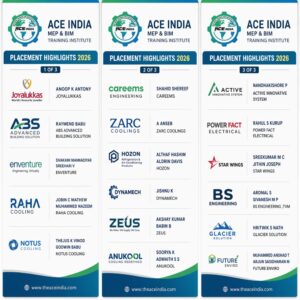
]]>
In today’s competitive engineering landscape, having a degree alone is no longer enough. What truly sets candidates apart is industry-ready skills, practical exposure, and the right guidance.
At ACE INDIA Training and Services Pvt. Ltd., we take pride in consistently delivering exactly that.
We are excited to showcase our Placement Highlights 2026, where our students have successfully secured opportunities in some of the most reputed companies in the MEP, HVAC, and Engineering sectors.
🎯 Our Latest Placement Achievements
Our students have been placed in leading organizations such as:
- Joyalukkas
- ABS Advanced Building Solution
- Enventure
- Raha Cooling
- Notus Cooling
- Careems
- Zarc Coolings
- Hozon
- Dynamech
- Zeus
- Anukool
- Active Innovative System
- Power Fact Electrical
- Star Wings
- BS Engineering (TVM)
- Glacier Solution
- Future Enviro
👨🎓 With multiple students placed in each company, this reflects not just individual success—but the strength of our training system and industry trust in ACE INDIA graduates.
🔗 Strong Industry Connections That Drive Real Placements
One of the biggest advantages of choosing ACE INDIA is our deep-rooted industry network.
Over the years, we have built strong relationships with:
✔ MEP contracting companies
✔ HVAC solution providers
✔ Electrical engineering firms
✔ BIM and design consultancies
✔ Facility management companies
These connections ensure that our students are not just trained—but directly connected to real job opportunities.
Our placement team actively coordinates with companies to match the right candidate with the right role, ensuring better career growth and job satisfaction.
🏗️ Why MEP & BIM Careers Are Booming
The construction and infrastructure sector is rapidly growing, creating massive demand for skilled professionals in:
- Mechanical (HVAC & Fire Fighting)
- Electrical Systems
- Plumbing (MEP)
- Building Information Modelling (BIM)
From commercial buildings to hospitals, malls, and smart infrastructure projects—MEP engineers are the backbone of modern construction.
This is why companies are actively looking for practically trained engineers, not just theoretical graduates.
🎓 Why ACE INDIA is the Right Choice for Freshers
Choosing the right institute can define your entire career. Here’s what makes ACE INDIA stand out:
✅ Industry-Oriented Training
Our courses are designed based on real project requirements—not just textbooks.
✅ Practical Exposure
Students get hands-on experience in:
- HVAC design
- Electrical systems
- Plumbing layouts
- BIM tools and software
✅ Experienced Faculty
Learn from professionals with real industry experience.
✅ Placement-Focused Approach
We don’t just train—we prepare you specifically for job roles in MEP & BIM companies.
✅ Proven Track Record
With 7000+ students trained since 2007, our alumni are working across India and abroad.
📈 From Fresher to Professional: The ACE INDIA Journey
Many of our students join us as fresh graduates or diploma holders with uncertainty about their career path.
Through our structured training, they gain:
- Technical confidence
- Software proficiency
- Interview readiness
- Industry exposure
And within a short span, they transition into working professionals in reputed companies.
🌟 Placement is Not a Promise — It’s a Proven Result
Unlike many institutes that focus only on training, ACE INDIA emphasizes end-to-end career development.
Our placement results are not marketing claims—they are real outcomes backed by consistent performance and industry trust.
The 2026 placement highlights clearly show that:
👉 Companies trust ACE INDIA students
👉 Students are getting real opportunities
👉 Careers are being built—not just courses completed
📍 Start Your Career with ACE INDIA
If you are a:
- Mechanical Engineer
- Electrical Engineer
- Civil Engineer
- Diploma Holder
Looking to build a career in MEP or BIM, this is the right time to start.
📅 New batches start every month
🌐 Visit: www.theaceindia.com
📞 Call: 9895320004
Summer vacations are a great time for children to relax — but they are also the best time to discover creativity, develop skills, and explore future career interests. Instead of spending long hours on mobile phones or television, parents today are looking for productive, skill-based programs that help children learn something meaningful.
ACE India introduces a 3D Building Design Summer Camp designed especially for students from Class 5 and above, where children learn design thinking, creativity, and basic engineering concepts in a fun and engaging way.
This is not just another vacation class — it is a Future Engineers Program that introduces kids to the world of architecture, 3D design, and visualization.
Why This Summer Camp is Important for Your Child
1. Develop Creativity & Imagination
Children learn how buildings are created and design their own dream house in 3D. This improves imagination, creativity, and problem-solving.
2. Learn Real Industry Software
Students are introduced to professional tools like:
- SketchUp (3D Modeling)
- Lumion (Visualization – Offline batch)
These are the same tools used by engineers & architects.
3. Learn From Industry Experts
The program is designed by ACE India — Professional Engineering Trainers since 2007, ensuring:
- Structured learning
- Kid-friendly teaching approach
- Hands-on practical sessions
- Expert guidance
4. Improve Logical & Spatial Thinking
3D design improves:
- Analytical thinking
- Planning ability
- Visual intelligence
- Engineering mindset
These skills help in academics and future careers.
5. Build Confidence Through Project Presentation
At the end of the program, students:
- Design their own project
- Present their ideas
- Receive certificate
This builds confidence and communication skills.
What Your Child Will Learn
Module 1 – Introduction to Building Design
- What is building design
- How houses and buildings are created
- 2D vs 3D understanding
- Spaces and layouts
Module 2 – SketchUp 3D Design
- Creating 3D shapes
- Designing rooms
- Creating house model
- Adding materials and colors
Module 3 – Advanced Model Development
- Adding furniture
- Improving designs
- Scene creation
- Visualization basics
Module 4 – Visualization (Offline Batch)
- Lumion introduction
- Rendering
- Environment creation
- Virtual walkthrough
Module 5 – Final Project
- Design your Dream House
Module 6 – Presentation & Certification
- Project presentation
- Feedback session
- Certificate distribution
Program Details
Offline Batch
Start Date: 16 April 2026
Time: 4:00 PM – 5:00 PM
Duration: 20 Days
Software: SketchUp + Lumion
Fees: ₹8,000
Online Batch
Start Date: 20 April 2026
Time: 11:00 AM – 12:00 PM
Duration: 20 Days
Software: SketchUp
Fees: ₹4,000
Age Group: 10 – 15 Years
Eligibility: Students from Class 5 and above
These details are provided in your official program outline.
Daily Class Structure (1 Hour)
- 10 mins – Concept explanation
- 40 mins – Practical learning
- 10 mins – Review & Q&A
Kids learn by doing, not just watching.
What Your Child Gets
- Course completion certificate
- 3D model project files
- Design images
- Hands-on experience
- Creative exposure
- Confidence boost
Benefits for Parents
Parents can expect their child to:
- Reduce screen time productively
- Learn new technology
- Improve creativity
- Develop future career interest
- Gain confidence
- Enjoy learning
This program helps children discover engineering & architecture at an early age.
Limited Seats – Early Registration Recommended
Small batch size ensures:
- Individual attention
- Hands-on guidance
- Better learning
Contact Details
ACE India
Phone: +91 98472 15677
Website: www.theaceindia.com
Why MEP & BIM Engineers Have a Strong Future
The world is constantly facing economic uncertainty, geopolitical tensions, and conflicts such as potential confrontations between global powers. Many industries experience instability during such events. However, one sector that consistently proves its resilience is the Architecture, Engineering, and Construction (AEC) industry.
From economic recessions to global pandemics and wars, the construction sector has repeatedly recovered and expanded. In fact, crises often create even greater demand for infrastructure development, urbanization, and rebuilding.
For young engineers and professionals, especially those specializing in MEP (Mechanical, Electrical, Plumbing) and BIM (Building Information Modeling), the future remains extremely promising.
How Global Conflicts Impact the Construction Industry
When conflicts or geopolitical tensions occur, the immediate effects may include:
- Supply chain disruptions
- Increased material costs
- Temporary project delays
However, history shows that construction activity quickly rebounds after instability because countries must rebuild infrastructure, housing, hospitals, transportation networks, and energy systems. Research on conflict-affected regions indicates that reconstruction and infrastructure development become major economic drivers once stability returns.
In simple terms:
War destroys infrastructure — rebuilding creates massive engineering demand.
This creates enormous opportunities for:
- Engineers
- Designers
- BIM specialists
- Construction professionals
The Ever-Growing Demand for Infrastructure
The global population continues to grow rapidly, and cities are expanding faster than ever before.
This leads to increasing demand for:
- Residential buildings
- Hospitals and healthcare infrastructure
- Airports and transport networks
- Data centers and smart buildings
- Commercial and industrial facilities
Experts predict that the construction sector will undergo major transformation driven by digital technology, sustainability, and urban growth, making it more efficient and innovative.
No matter what happens geopolitically, people still need buildings, homes, offices, and infrastructure.
And every building needs MEP services.
Why MEP Engineering Will Always Be in Demand
In modern buildings, nearly 40–60% of project cost is related to building services such as HVAC, electrical systems, fire protection, plumbing, and energy management.
Without MEP systems, a building cannot function.
MEP engineers are responsible for:
- Air conditioning and ventilation (HVAC)
- Electrical power distribution
- Fire protection systems
- Plumbing and drainage systems
- Building automation systems
With the rise of smart buildings and energy-efficient design, the importance of MEP engineers is growing every year.
Future buildings will depend even more on:
- Energy-efficient HVAC systems
- Smart lighting
- Renewable energy integration
- Building automation systems
This ensures long-term career stability for MEP professionals.
Why BIM Is Becoming the Backbone of the Construction Industry
Building Information Modeling (BIM) is transforming how buildings are designed, constructed, and managed.
Many governments worldwide are now making BIM mandatory for large projects, especially in public infrastructure.
Today BIM is used for:
- 3D coordination between disciplines
- Clash detection before construction
- Cost estimation (5D BIM)
- Project scheduling (4D BIM)
- Facility management and digital twins
The global BIM market is expanding rapidly and is expected to reach billions of dollars as digital construction becomes standard practice.
This means companies around the world are actively searching for skilled BIM professionals.
How AI, IoT, and Digital Technologies Are Transforming Buildings
The future of construction will be deeply connected with technology.
Emerging technologies that will impact the AEC industry include:
Artificial Intelligence (AI)
AI is already being used in BIM workflows for:
- Automated clash detection
- Design optimization
- Predictive scheduling
- Risk analysis
AI helps engineers complete complex tasks faster and with greater accuracy.
Internet of Things (IoT)
IoT allows buildings to become smart and responsive.
Examples include:
- Smart energy monitoring
- Intelligent HVAC control
- Predictive maintenance
- Real-time building performance monitoring
Digital Twins
A digital twin is a virtual replica of a building that continuously updates using real-world data.
This allows engineers and facility managers to:
- Monitor building performance
- Optimize energy consumption
- Detect system failures early
These technologies are reshaping the AEC industry and creating new job roles for engineers with BIM and digital skills.
Why India Will Play a Major Role in Global BIM and MEP Services
India is rapidly becoming a global hub for engineering outsourcing and BIM services.
International construction companies increasingly rely on Indian engineers for:
- BIM modeling
- MEP design support
- Clash detection and coordination
- Quantity take-offs
- Construction documentation
Many firms operate with hybrid global teams, where design coordination happens across multiple countries.
This creates huge opportunities for engineers in India to work on international projects from India itself.
Why Fresh Engineers Should Consider Careers in the AEC Industry
Many young engineers today focus only on IT or software jobs. However, the AEC industry offers equally exciting opportunities, especially with digital transformation.
Benefits of choosing MEP or BIM careers include:
✔ Global job opportunities
✔ Work on iconic international projects
✔ High demand for skilled professionals
✔ Opportunities in smart city development
✔ Rapid technological advancement
✔ Long-term industry stability
The Future: Smart Cities and Sustainable Infrastructure
Governments worldwide are investing heavily in:
- Smart cities
- Sustainable infrastructure
- Green buildings
- Renewable energy systems
These initiatives will require millions of engineers globally.
Every smart building requires:
- Advanced HVAC systems
- Intelligent electrical systems
- Water management systems
- Energy optimization
Which means MEP and BIM engineers will be at the center of this transformation.
Conclusion: The AEC Industry Is Future-Proof
Despite global uncertainties, the AEC industry continues to evolve and grow.
From rebuilding infrastructure after crises to developing smart cities for the future, construction will always remain a cornerstone of economic development.
With the integration of AI, IoT, BIM, and digital engineering, the AEC industry is entering one of its most exciting phases.
For engineers looking for a stable, innovative, and globally relevant career, the path is clear:
MEP + BIM + Digital Construction = The Future of Engineering.
]]>
The construction industry across the world is rapidly evolving with advanced technologies like MEP Engineering and Building Information Modelling (BIM). Skilled professionals who understand modern building services systems are in high demand in India, the Middle East, and across international construction markets.
To bridge the gap between academic education and industry requirements, ACE India Training and Services Pvt. Ltd. offers industry-oriented Online MEP and BIM Training Programs designed for both fresh engineering graduates and working professionals.
Unlike typical recorded online courses, ACE India delivers live interactive classes with experienced industry trainers, ensuring that candidates gain real practical exposure to real-world engineering projects.
About ACE India – Pioneer in MEP & BIM Training Since 2007
Established in 2007, ACE India has built a strong reputation as one of the leading institutes in India for MEP (Mechanical, Electrical, Plumbing) and BIM (Building Information Modelling) training.
With years of experience in training, consultancy, and industry collaboration, ACE India has successfully trained thousands of engineers who are now working in:
-
India
-
Middle East (UAE, Qatar, Saudi Arabia, Oman, Kuwait)
-
Europe
-
International construction companies
ACE India is not just a training institute — it is also involved in MEP and BIM consultancy projects, which gives students the opportunity to gain exposure to real international projects during the training itself.
Why Choose ACE India Online MEP & BIM Training?
Most online courses today rely heavily on pre-recorded videos with minimal interaction. ACE India follows a completely different approach focused on interactive learning and practical exposure.
Live Interactive Classes with Experienced Trainers
All classes are conducted through live sessions on Google Meet, where candidates can directly interact with trainers and clarify their doubts instantly.
This ensures:
• Real-time interaction
• Better understanding of concepts
• Immediate doubt clearing
• Personal guidance from trainers
Students are not just passive viewers — they actively participate in the learning process.
Convenient Timing for Working Professionals
The classes are scheduled at a convenient time to support working professionals, especially those working in the Middle East.
Class Timing:
8:30 PM IST – 10:00 PM IST
This allows professionals from:
-
India
-
UAE
-
Qatar
-
Saudi Arabia
-
Oman
-
Kuwait
to attend classes comfortably after work hours.
Recorded Sessions for Revision
After every live class, recorded sessions are shared immediately with students.
This helps candidates:
-
Revise complex concepts
-
Catch up if they missed a class
-
Learn at their own pace
Students therefore benefit from both live interaction and recorded learning support.
Industry-Oriented Training – Beyond Theory
One of the major advantages of studying at ACE India is the industry-oriented training approach.
Instead of focusing only on theory, the training includes:
• Practical case studies
• Real project examples
• Design exercises
• Industry-based assignments
Students also get exposure to live consultancy projects handled by ACE India, helping them understand how engineering works in real construction projects.
This practical exposure is extremely valuable for candidates who want to build a strong career in the building services industry.
Software Covered in the MEP Training Program
The MEP course includes training on industry-standard design software used by engineering consultants and contractors worldwide.
Students will learn:
-
AutoCAD
-
Revit MEP
-
Dialux (Lighting Design)
-
ECAD
-
HAP (HVAC Load Calculation)
-
McQuay Tools
-
HVAC Design Concepts
-
Electrical Design
-
Plumbing Design
-
Fire Fighting Systems
The course also covers both Indian and international standards, ensuring students are ready for global opportunities.
BIM Software Covered in the BIM Training Program
ACE India’s BIM training program focuses on modern digital construction technologies used worldwide.
Students will learn:
-
Revit Structure
-
Revit Architecture
-
Navisworks
-
Primavera
-
SketchUp
-
Lumion
These tools are widely used in international BIM projects and modern construction environments.
Real Project Exposure
One of the biggest advantages of training with ACE India is the opportunity to work on live consultancy projects.
Since ACE India is actively involved in MEP and BIM consultancy, students get exposure to:
• Real design drawings
• Coordination models
• Project documentation
• International project standards
This gives candidates a practical understanding of real engineering workflows, which is highly valued by employers.
Placement Support for Candidates
ACE India provides placement assistance to candidates who are interested in job opportunities.
The institute maintains strong connections with:
-
MEP consultants
-
Construction companies
-
BIM firms
-
Contractors
-
International companies
Many students trained at ACE India are currently working in:
-
UAE
-
Saudi Arabia
-
Qatar
-
Oman
-
Kuwait
-
India
This strong industry network helps students build successful careers in the building services sector.
Who Can Join This Course?
ACE India’s MEP and BIM training programs are suitable for:
Fresh Engineering Graduates
-
Mechanical Engineers
-
Electrical Engineers
-
Civil Engineers
-
Architecture Graduates
Working Professionals
-
Engineers working in construction
-
Engineers looking to shift into MEP or BIM
-
Professionals planning to move to the Middle East
The course is ideal for anyone looking to build a career in the building services industry.
Career Opportunities After MEP & BIM Training
After completing the course, candidates can work in roles such as:
-
MEP Design Engineer
-
HVAC Design Engineer
-
Electrical Design Engineer
-
Plumbing Design Engineer
-
BIM Engineer
-
BIM Coordinator
-
BIM Modeler
-
MEP Project Engineer
These roles are in high demand in construction companies, MEP consultants, and international design firms.
Why Building Services Engineering Is a Growing Industry
Modern buildings require advanced systems for:
-
HVAC (Heating, Ventilation & Air Conditioning)
-
Electrical Power Distribution
-
Lighting Systems
-
Plumbing Systems
-
Fire Protection Systems
This entire domain is known as Building Services Engineering, and it is one of the fastest-growing sectors in the global construction industry.
With the rise of smart buildings, green buildings, and BIM technology, the demand for trained MEP and BIM professionals continues to grow rapidly.
Start Your Career with ACE India
For candidates who want to enter the building services industry or upgrade their career with modern construction technologies, ACE India’s online MEP and BIM training programs provide the perfect platform.
With live interactive classes, industry-oriented training, real project exposure, and placement support, ACE India ensures that students gain the skills required to succeed in today’s competitive construction industry.
Contact ACE India
ACE India Training and Services Pvt Ltd
Edappally, Kochi – Kerala, India
🌐 Website:
www.theaceindia.com
📞 WhatsApp / Enquiry:
+91 9847215677